Many adults will require assistance to carry out oral health care. This may be due to a variety of medical, physical or psychological issues like poor manual dexterity, muscle or nerve damage or weakness, fatigue or poor concentration, or reduced awareness and sensation in the mouth.
Examples include:
- Learning disabilities or autism
- Dementia
- Parkinson’s Disease
- Stroke
- Multiple Sclerosis
- Mental health illness
It is important to encourage independence as much as possible, but if the person you support is unable to carry out effect toothbrushing and oral hygiene you may need to help them, to prevent dental disease – like decay or gum disease.
Tips for Independence
- Bring the person the equipment to brush their own teeth
- If possible, sit down at the sink or use a basin in bed
- Use a mirror and good lighting
- Add oral care into your daily routine – perhaps when in the bathroom carrying out
daily bathing - Use timers, reminders, checklists, or toothbrushing apps
- Create a star chart to track progress
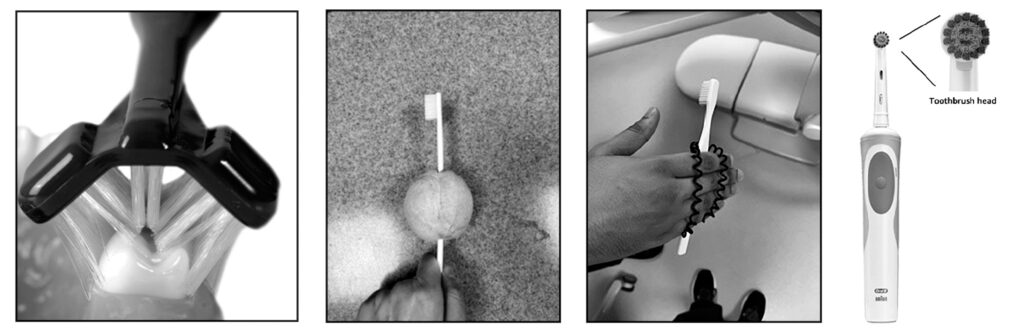
- It may be helpful to use a three-sided toothbrush
- Use a large-handled toothbrush, modify the toothbrush handle (see pictures) or use an electric toothbrush with an oscillating-rotating movement
For Carers and Family Members
Your Role Is Important:
- Offer help with brushing or denture care
- Supervise and prompt the person
- Assist with positioning and support
- Remind to remove dentures at night
- Monitor for signs of discomfort
- Record any changes in care logs
- Make regular appointments for dental check-ups, or if you have any concerns
If more support is required
- Explain actions and ensure dignity
- Stand behind the person in front of the mirror
- Ensure that they are upright, their head is supported and encourage them to adopt a chin-tuck position
- Use a hand-over-hand method, guiding the person to brush themselves
- If this is not possible brush the teeth for 2 minutes, in stages if required
- Allow the person to spit out excess toothpaste
- Don’t encourage the person to rinse with water
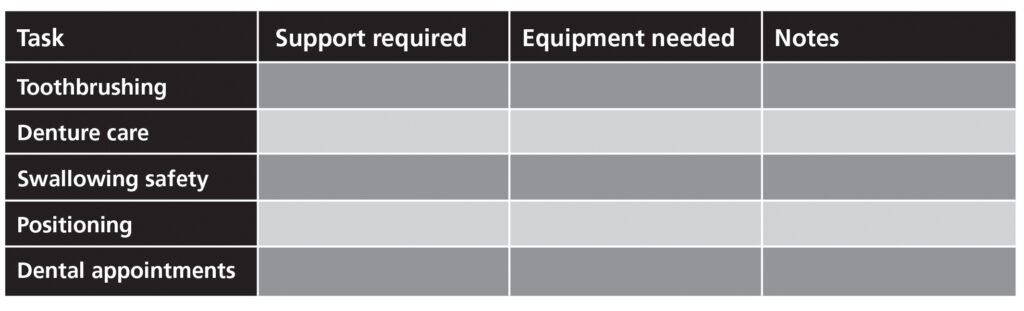
Your Personal Oral Health Care Plan
The dentist can help you create your own personal oral health care plan (see example below).